 Brand House
You asked what to do about the brand. To answer that properly I had to go and size the market you are actually operating in, so most of what follows is data you have not seen before, and then a recommendation on the name that I think will surprise you.
You have two trades brands and an ecommerce brand, bought separately, running on what looks like the same website template off the same server. The work behind them is good. The packaging around them is doing very little.

Trading since 1993. Residential is the bulk of it today. Sitting at 4.7 stars on 679 Google reviews as of this week, and if you read the review text a theme repeats: people say you did not push work they did not need.

Family-run since 2004 and the bigger half of the group, carrying more than half of revenue. 4.8 stars on 427 reviews, and Yahoo Local's 2026 ranking put it first among Tampa plumbers, above every private-equity-backed operator on the list.

Wholesale HVAC and plumbing equipment shipped anywhere in the lower 48, freight baked into the price. You have kept it outside the rebrand on purpose. Thin margins, a reputation inherited from the previous owners, and paid search that is burning money.

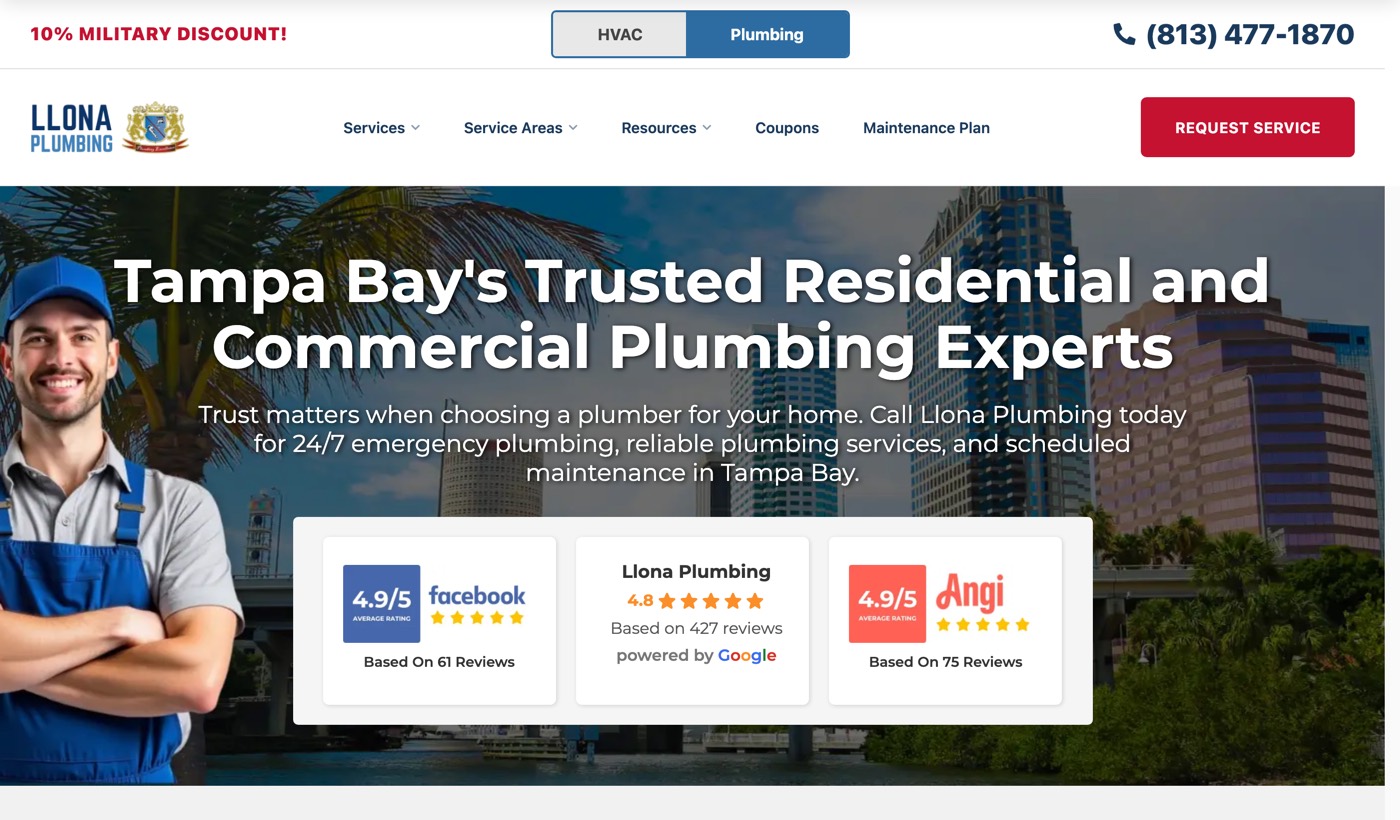
Same header bar, same HVAC and Plumbing toggle, same call-to-action button in a different colour, and the same stock photograph of the same man in blue overalls with his arms folded. Both sites lead with a 10% military discount above everything else, which you told me is not converting anybody. You are paying for two brands and getting one, twice.
I built this from Census housing records for all 153 ZIP codes across your five counties, then aged the equipment against how long a system really lasts in Florida. Treat it as a directional estimate of replacement stock rather than a market you can go and take. Every assumption is printed below so you can pull it apart.
Coastal exposure is reckoned to cut useful equipment life by 20 to 30 percent against inland markets, taking a ten year system down to seven or eight. So the model runs an 8.5 year life on the 29 most water-exposed ZIPs and twelve years inland. It is also the reason Pinellas throws off $239M a year with almost no new construction. That stock is old, it is on the water, and it turns over faster than anywhere else you serve.
Reproducible from public files. None of it comes from a vendor deck.
I would rather you hear this from me than from a lender.
Everyone in this competitive set sits between 4.7 and 4.9 stars, so stars are not what separates anybody. What separates them is how much evidence a stranger sees before they decide who to call. On that measure you are a long way back.
The top three hold something like 27,000 reviews between them against your 1,100 across two companies. Closing that gap is an operations change rather than a marketing spend: the review request has to become a step in closing the job, the same way collecting payment is. At forty jobs a week and a thirty percent capture rate Pronto clears 1,200 inside a year, and that costs you nothing but the discipline to enforce it. Review volume is not the only thing that decides who gets the call, but it is the cheapest of them to fix.
This is the part that should shape a five year plan more than any logo will.
Apex makes the better slide, but on a Tuesday in Riverview the operator taking your work is whoever holds the map pack for that ZIP and answers the phone at a profit. On the commercial side it is whoever already sits on your GC's approved vendor list. Neither of those shows up in a review count, and finding out who they are per ZIP is a fortnight of work I have not done yet.
Every van is white with black lettering. There is a company here that Andrew is infatuated with, and they are pink. The trucks are pink. People remember that pink. From your own brand research, on white van syndrome in Tampa
Scored on how much 2010s housing sits there, how many replacements the model expects, what the household earns and how much of it is owned rather than rented. One caveat you should know: two of those four inputs come out of the same equipment-life assumption, so the score partly rewards its own maths. Use it to pick where to run a test, not to set a budget.
| ZIP | Place | County | Score | Built 2010s | Median income | Median age | Owner | Annual value |
|---|---|---|---|---|---|---|---|---|
| 33578 | Riverview | Hillsborough | 86.3 | 8,076 | $80,223 | 35.0 | 58% | $10.6M |
| 34221 | Palmetto | Manatee | 80.3 | 3,989 | $74,314 | 46.6 | 80% | $15.5M |
| 33579 | Riverview | Hillsborough | 78.8 | 6,950 | $113,568 | 35.6 | 82% | $8.0M |
| 33647 | Tampa (New Tampa) | Hillsborough | 75.8 | 5,517 | $104,775 | 37.0 | 60% | $10.8M |
| 34211 | Bradenton (Lakewood Ranch) | Manatee | 70.3 | 6,633 | $118,565 | 48.5 | 82% | $4.3M |
| 33598 | Wimauma | Hillsborough | 67.2 | 5,353 | $91,649 | 35.8 | 87% | $5.4M |
| 33543 | Wesley Chapel | Pasco | 65.3 | 4,030 | $107,565 | 38.9 | 85% | $7.4M |
| 33573 | Sun City Center | Hillsborough | 64.6 | 3,388 | $68,431 | 68.5 | 84% | $8.5M |
| 34212 | Bradenton | Manatee | 64.1 | 4,406 | $119,298 | 49.4 | 84% | $6.0M |
| 34655 | New Port Richey | Pasco | 63.1 | 2,592 | $85,107 | 45.7 | 78% | $9.8M |
| 33570 | Ruskin | Hillsborough | 62.9 | 4,031 | $69,048 | 36.7 | 75% | $6.7M |
| 34219 | Parrish | Manatee | 62.7 | 3,678 | $104,258 | 46.1 | 89% | $6.6M |
| 34638 | Land O'Lakes | Pasco | 62.5 | 3,939 | $117,931 | 37.7 | 83% | $6.3M |
| 33556 | Odessa | Hillsborough | 61.3 | 3,006 | $151,034 | 40.9 | 86% | $7.6M |
| 34202 | Bradenton (Lakewood Ranch) | Manatee | 60.4 | 3,830 | $123,210 | 54.2 | 79% | $5.7M |
| ZIP | Place | Estabs | Employees |
|---|---|---|---|
| 33607 | Tampa (Westshore) | 2,414 | 81,997 |
| 33619 | Tampa (East) | 2,008 | 46,552 |
| 33602 | Tampa (Downtown) | 1,925 | 37,980 |
| 33511 | Brandon | 2,114 | 24,693 |
| 33634 | Tampa (Airport) | 1,389 | 45,546 |
| 33609 | Tampa (Palma Ceia) | 1,793 | 26,461 |
| 33610 | Tampa (North East) | 1,318 | 38,820 |
| 33701 | St Petersburg | 1,600 | 25,369 |
They are separate campaigns and they should never share a budget line.
Hillsborough is expected to absorb around 121,000 of them, and county permit volume is growing again at 18 to 19 percent a year after the 2021 to 2024 slump. On top of that the region takes on roughly 200,000 seasonal residents between November and April, which produces a startup-failure spike over November and December and a pre-shutdown wave in April and May. Build the marketing calendar around those two spikes rather than spending evenly across twelve months.
Residential covers the bills today and is where the data says to hunt. Commercial is where you have said the business is heading. They want different things, they are reached in different places, and one message will not do for both.
Sixty-five plus, owns the house outright, lives in Sun City Center, Hernando or the older Pinellas stock, household income under $70,000. Has either been burned by a contractor or knows somebody who was, and is exactly who the bad operators in this market go looking for.
Buys on: an honest number, given once, that does not move.
Worries about: being sold something they have no way to check.
You reach them through: neighbours, community boards, mail, and a phone answered by a person.
What wins them: financing and maintenance plans, sold as protection rather than as a payment plan.
Mid thirties to mid forties in Riverview, Wesley Chapel, Parrish or Land O'Lakes, earning $100,000 to $120,000. Bought new somewhere between 2012 and 2018 and has never replaced anything, so the builder-grade system that came with the house is now on borrowed time.
Buys on: speed, a booking they can make from a phone, and proof from people nearby.
Worries about: a Saturday with no air conditioning and two kids in the house.
You reach them through: paid search, your Google Business Profile, and mail targeted by build year.
The opening: they have no idea their system is due, so tell them before it quits.
Runs property in Westshore, downtown Tampa, Brandon or the airport corridor. Gets measured on uptime and on budget both, so price still matters, it is just not the only thing on the list. Keeps a short mental shortlist and adds to it rarely.
Buys on: responsiveness, documentation, and one name to hold accountable.
Worries about: a tenant complaint they have no answer for.
You reach them through: a referral from another chief engineer, then a credential check online.
The opening: proactive reporting, because nobody in this market sends them anything before something breaks.
Sat on bid boards pricing plumbing and mechanical packages for multifamily, medical and mixed-use. Sometimes they decide, sometimes they are two steps below whoever does, and you often will not know which until late.
Buys on: a bid in on time, at a number they can defend, with licences and bonding already proven.
Worries about: a subcontractor who cannot hold a schedule.
You reach them through: bid portals, and the relationships your field operations director already has.
What is missing: a credentials page and a project list good enough for a stranger to say yes off.
Commercial work comes in almost entirely through one person's relationships. He is very good and he is also a single point of failure. Everything you build on the commercial side from here should be designed to move his credibility onto the company rather than keep leaning on it: case studies with his name on them, a project list, a second person shadowing the relationships, and a referral process that exists somewhere other than his head. That is a brand job with an operational payoff, and I would do it before I touched a logo.
The positioning Cardigan landed on holds up, and the market data backs it rather than fighting it. I have left their language alone and added the parts it was missing, which are proof, priority and somewhere to spend.
AGSB is the property services partner for home and business owners who deserve better. We equip seasoned tradespeople with business discipline to restore the kind of service experience that earns a callback.
Two audiences with the same complaint. The rare part is not the trade skill, which plenty of people have. It is putting business discipline behind it, and the result is work somebody bothers to call you back for.
Is: trusted, loyal, human, direct, friendly, elevated, proactive, proud.
Is not: fancy, corporate, serious, stuffy, silly.
The tension to protect is elevated without corporate. Raising the bar does not mean putting plumbers in blazers. It means giving the work, and the people doing it, the respect it always deserved.
We do not do the minimum and move on. We fix the whole problem, not just the part you called about. Good enough is not a standard we recognise.
We show up on time and we answer when you call. Service is relational rather than transactional, and good service compounds into a reputation.
We tell you what is wrong, what it will cost, and what we would do in your position. No surprises when the invoice arrives.
Read through Pronto's 679 reviews and the line that keeps coming back is that you did not sell them anything they did not need. That is Clarity, in public, from strangers, unprompted. Which means the job here is amplification rather than invention, and that is a much cheaper problem than the one most companies in your position have. Worth doing properly: a structured read of all 1,100 reviews would turn that impression into evidence you could actually put in front of a buyer.
You already know why Llona and Pronto have to go. What follows is the other column, which I do not think has been costed, and then how I would sequence it.
Google reviews attach to the Business Profile, not to the name written on it. Rename the profiles you already have and the reviews, the photos, the listing age and the local ranking signal come across with you. Let somebody create new listings instead and you start at zero. That decision is worth more than the whole naming exercise and it usually gets made by a junior person at a web vendor with nobody watching. Same story with the domains: redirect page by page rather than replacing, and keep the old ones renewed for years. To be straight with you, a clean rename protects the reviews and the listing age. It does not guarantee your rankings hold, and directory citations across a few dozen sites will need cleaning up by hand.
Branded search volume, map-pack calls, organic calls, booked jobs, close rate, review velocity, commercial referrals and bid invitations, split by brand. A fortnight of setup. Without it, every argument about whether the rebrand worked will be somebody's opinion.
Least at risk, clearest category gain, and it proves the migration works on the smaller book before you go near the one carrying half your revenue. Rename across Google, Yelp, BBB and the field service software on the same day, and redirect the domain rather than retiring it.
Llona Plumbing, a Wainwright company. Keeps the search rank and the ranking intact, gives the referral network time to learn the new name off a familiar one, and lets the commercial team lead with Wainwright in the rooms where Llona was a ceiling.
Drop the endorsement when branded search for Wainwright, review velocity on the renamed profiles and commercial inbound have all held for a quarter against that baseline. If they do not hold, you stop and find out why before going further.
Keeping the ecommerce brand separate for competitive reasons is the right call and I am not going to argue with it. It needs its own plan, because its problem is different: margin and reputation repair in a category where the biggest ad budget usually wins.
You should hear the other case put properly, because it is a good one.
Your actual problem is that the current names block commercial credibility and hide the category. A drawn-out endorsement period leaves you teaching two names at once, with two sets of signage, two phone scripts and a hundred chances for staff and customers to keep defaulting to the old one. If renaming the profiles really does protect the search equity, then the biggest risk I have named is already handled, and a clean single launch would serve the acquisition story, the recruiting brand and the commercial ambition faster.
I still land on phasing, and only because Llona is more than half of revenue with relationship-dependent commercial work, and you have debt service and working capital that make a dip expensive. If those two things were not true I would tell you to rip the plaster off.
Sequenced so the cheap things that compound happen first, and so nothing sits waiting on the visual identity to land.
Take the military discount out of both hero areas and put a booking action there instead. Make the review request a required step at job close rather than a favour. Enforce source capture in the field service software so attribution becomes worth reading. Fix the responsive breakpoints. None of that needs the rebrand, an agency or a budget.
Whoever you appoint on paid search gets the ZIP list rather than a brief asking them to invent one. Run a handful of those ZIPs against similar ones you leave alone, so you can tell the difference between the campaign and the weather. Layer mail into the 2010 to 2014 subdivisions, timed to the November and April spikes. Give it a full quote-to-close cycle before you judge it, which in this trade is weeks rather than days.
A credentials page, a project list, three named case studies, and a proactive reporting habit nobody else in this market bothers with. Aim it at the eight commercial ZIPs. This is the work that turns one person's reputation into the company's.
Run the sequence above. Publish consistently the whole way through so the search and AI visibility you currently do not have starts building against the new name rather than after it.
You told me the plan is eighty percent commercial, that residential has to keep running because of cash flow and debt service, and that commercial growth needs key hires and working capital. Nothing on this page tells you how much gross profit residential has to throw off, at what margin, to fund the estimators, the bonding, the working capital and the bids you will lose on the way to that split. Market size does not answer it. Unit economics and capital requirements do, and that is a conversation with Jeff and me together once your numbers are in shape. Until it is answered, the honest position is that the paid media budget, the rebrand timetable and the question of whether an acquisition gets you there faster are all still open.